
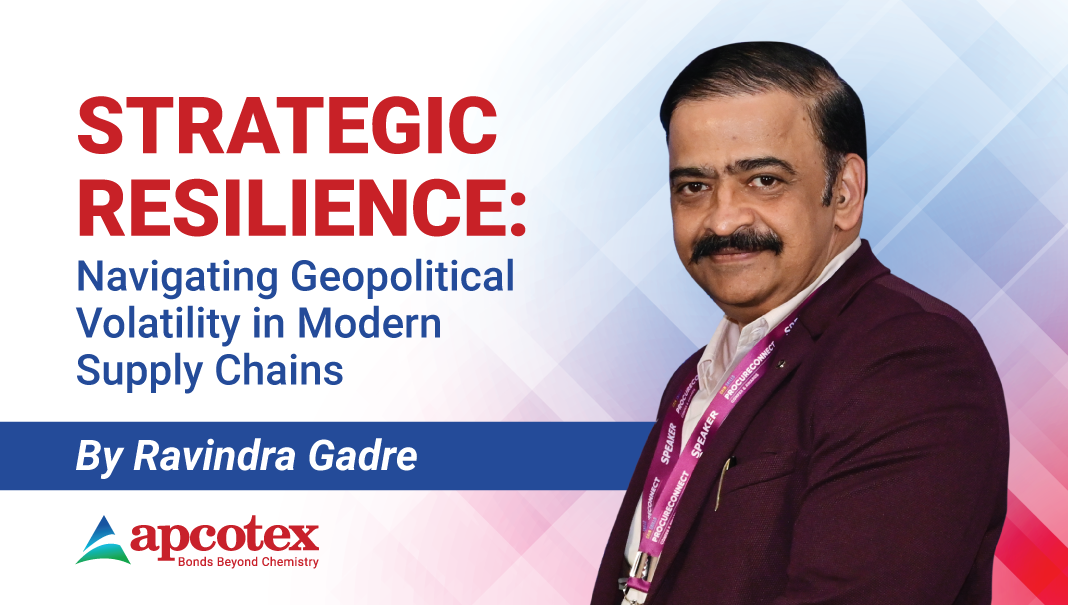
In the contemporary global trade landscape, the transition from Volatility to Visibility is no longer a strategic choice but a fundamental necessity for operational survival. Ravindra Gadre, Chief Procurement Officer at Apcotex Industries Ltd., recently detailed a framework for managing geopolitical risks and strengthening supply chain resilience in a period of unprecedented global upheaval.
The prevailing mandate for supply chain leaders is clear: we must pivot from “Just-in-Time” efficiency to “Just-in-Case” resilience.
A Framework for Disruption Management
Practical risk mitigation begins with a standardized Severity Classification. By categorizing events based on their operational impact, organizations can deploy resources more effectively:
Monitoring Global Lead Indicators
Visibility is achieved by identifying and monitoring “Lead Indicators”—geopolitical flashpoints that signal impending disruption. Current critical areas include:
- The Strait of Hormuz
Heightened military posturing, such as the buildup of U.S. naval and air power in the vicinity of Iran, serves as a primary indicator for evaluating products sourced from the US and EU.
- The Strait of Malacca
This region is emerging as a central flashpoint due to the “major defense cooperation partnership” between the U.S. and Indonesia announced in April 2026.
- Great-Power Competition
The expansion of military presence—China through port networks and the U.S. through base access—directly impacts maritime chokepoints including the Mindoro, Makassar, and Lombok Straits.
From Reactive to Predictive: The Future State
The current “Status Quo” is often characterized by overnight tariff shifts, trade restrictions appearing without warning, and manual data analysis gaps. To move forward, organizations must embrace a paradigm shift:
“Stop assuming an ideal world and transition into a proactive mode that prioritizes visibility and agility over rigid, long-term strategic planning.”
Practical Steps for Implementation
- AI Integration: Actively monitor predictive analytics using AI tools to identify risks before they cascade through the supply chain.
- Risk Hierarchy: Formally identify the geopolitical risk hierarchy specific to your material dependencies.
- Operational Gap Analysis: Conduct thorough identification of operational blind spots to maintain a competitive advantage.
- Dynamic Inventory Management: Shift toward optimized inventory management based on real-time disruption data rather than historical averages.
By investing in visibility and agility, organizations can transform their supply chains into responsive systems capable of thriving amidst a changing world order.
Watch the Video: https://youtu.be/3YSdi4IF3_E